
Book Descriptions
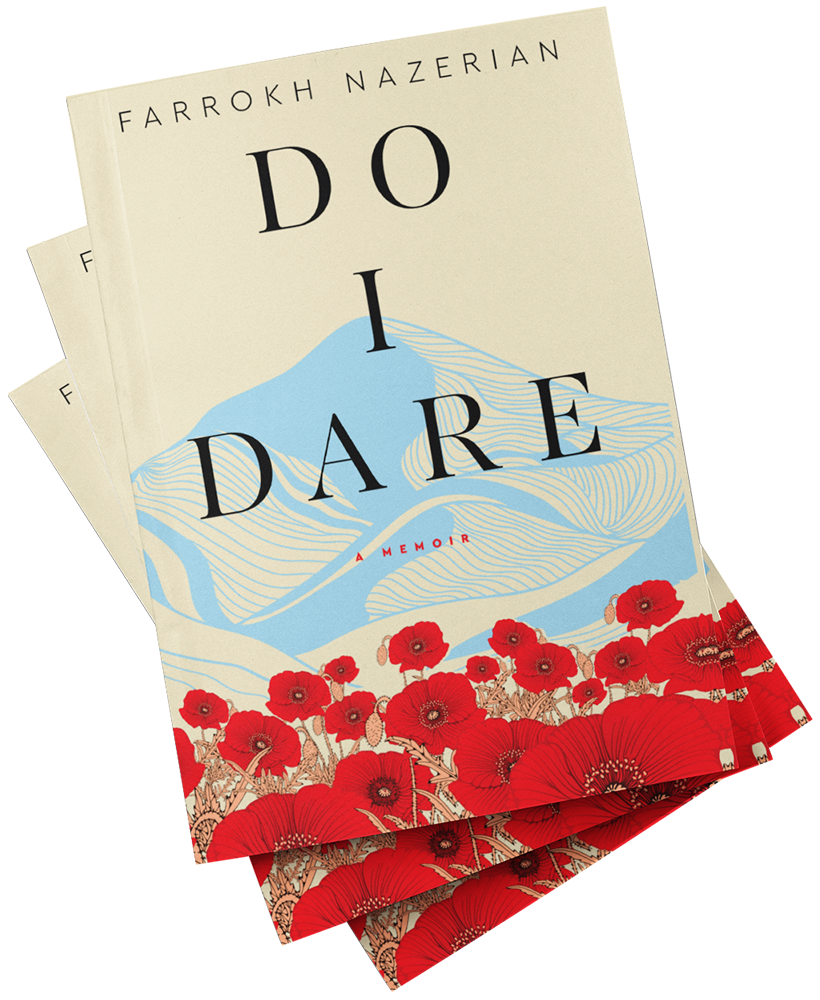
Do I Dare
A Memoir
Do I Dare, a memoir, is a collection of stories about the life of Farrokh Nazerian. Tracing his beginnings and childhood in Iran during the 1950s and 60s, Farrokh details the formative roots of his knowledge, history, philosophy, and creative spirit, which become a springboard for his future accomplishments and successes. As a sixteen-year-old journalist, he was arrested on two occasions for his critical views on the Shah and the Iranian government.
As a young man Farrokh secured a job within an Iranian company where he flourished. Eventually, he was assigned to work with a sister company in London, while still attending and completing his university studies in Iran at the University of Tehran. Through a series of calculated steps, Farrokh manages to take up residence in England and forges a new life as a successful entrepreneur before the Shah’s regime falls. Later, he marries a British woman and they move to America where he raises his three children and cultivates a thriving business as a real estate developer.
In his memoir, Farrokh reflects on his life, his travels, and his family, often exploring the deeper meaning of things with solid ties to Persian poets and world philosophers.

The Last Person Who Saw Farrokh
A Play by Farrokh Nazerian
Amazon Five Star Reviews
Amazing and thought-provoking read! Invites one to review the play of one’s own life. All of us are looking for Farrokh, and will ultimately be frustrated in that search. The secret may be to become him. Wonderful!
An astounding masterpiece not to be missed This work is Avant Garde, and in so being when Nazerian pushes the boundary of reality in his story telling, he not only unveils to humanity their own unknown potentials, but articulates the universal truths in a new and awesome way. For me this is an excellent rendering of the human experience, past present and future transcended. Nazerian carries me through the narrative smoothly, so smoothly in fact that I can’t help but put my own face and my own experiences into the characters and events. Storytelling on that level needs to be cherished. In the play he readily references the Persian poet Hafiz, which helps shed light on the mysticism of the work. And the amount of quotable ideas in this work of art explode and resound in my mind even after each re-read, making it a valuable bank of new ideas. I reference this book often in my own work, and am grateful to have stumbled upon its rich mastery of the universe and our presence within it.